10/5/10

Review of 'Thelonious Monk: The Life and Times of an American Original' by Robin D.G. Kelley

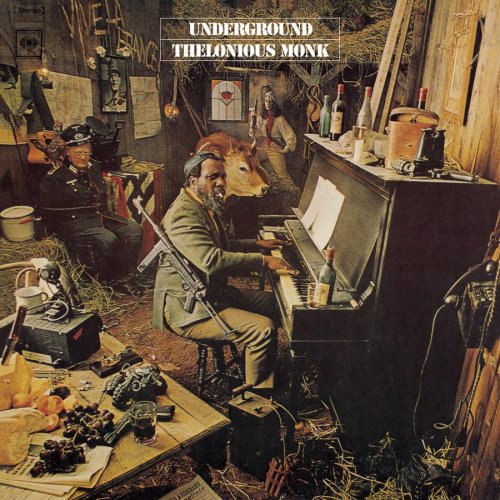
The one book that had been sitting in the "must-read" pile on my nightstand far too long was Robin D. G. Kelley's Thelonious Monk: The Life and Times of an American Original.  Truth is, I was saving it for the laziest, most pleasant days of my summer break, as Monk's records and I go way back to when I was 10 or 11 years old and I discovered 1968's Underground in a relative's old record collection.  The cover alone was some far out shit, still more the music inside.  When I got older and got good enough on the guitar to buy my own fake book, I took a look at the lead sheets for Monk's tunes -- something like "Well, You Needn't," just up and down the neck, right -- and figured I could learn the song.  Well, I could play the melody and the chords all right, but the whole thing sounded like a dog's lunch.  In other words, a mess.
     As Kelly's outstanding biography makes clear, Monk as a man and as a composer was his own man -- bold, original, uncompromising, and rooted so deeply in place that when you encountered his oeuvre, you had to go him, because he wasn't going to come to you.  Weighing in -- appendixes, notes, and index -- at almost 600 pages, The Life and Times is an appropriately weighty treatment of a musical figure whose center of gravity continues to be affecting the musical orbits of all planetary bodies in motion.
     As a public service of the first order, Kelley dispels the persistent myths of Monk as a savant, as a mystic, as hopelessly eccentric, as anything less than a full man who took his art and his independence seriously.  Along the way, readers will also get to the bottom of the crooked and discriminatory cabaret card system in New York City and the bizarro world of musicians' unions and music copyrights.  Tied up in this, as well, is a brutal picture of how race factored into the criminal justice/mental health system in the US, and how musicians who were underpaid and overworked often kept themselves going with chemicals -- in Monk's case, alcohol, nicotine, "vitamin shots" from Dr. Robert, and the occasional recreational drug.  All these impediments -- bad press, insufficient health care, crooked businessmen, and run-of-the-mill substance abuse -- didn't keep Monk from being himself and writing his songs.
     Monk was a family man and a neighborhood guy, brought from North Carolina to New York City in 1922 by a mother who preferred the opportunities of the urban north to those of the rural south.  In the Monks apartment in San Juan Hill, there was a piano, and Thelonious started playing when he was six, taking lessons across all kinds of musical genres, to the point where, in his late teens, he was skilled enough to tour the nation playing keyboard for a traveling preacher.  The picture Kelley paints of Monk is of a young man who is deeply interested in music, provincial in the way that New Yorkers can be, and guided by some inner compass of confidence and strength, no doubt instilled in his by mother, with whom he was close until the day she died.
     As the 30s give way to the 40s and swing bands give way to bebop, we find Monk at the forefront of the music, in conversation via the aural tradition of jazz -- Dizzy Gillespie, Charlie Parker, and Monk all had a hand in creating the high modern sound.  But we see that the extrovert, Diz, and the axtrovert, Bird, are the ones who got much of the credit, while Monk, who built the chair for everyone to sit on, had to wait a decade or so for people to understand what he actually did.  Until then, Monk, who was clearly introverted and let his piano do the talking -- however clunky and dissonant it might sound to the unschooled ear.  When bad luck and rumors prevent him from working in New York, Monk could be found hanging out at his apartment in the city, jamming with Sonny Rollins or John Coltrane, teaching the new harmonics to anyone willing to listen and who could keep up.  By the mid-50s, as the mainstream catches up with Monk, we find him able to make a living some years, but the grind of poverty, of keeping his family together, of the ever-creeping swings of his untreated bipolar disorder -- all those factors make even the broad success and popularity of the 1960s a bittersweet affair.
     When Monk made his last public performance in 1975, even as the importance of his music was steadily growing, he had been retired from life as a working musician for a few years already.  By the time of his death in 1982 -- folks might forget how long the silence was at he end of his life -- he had retreated to the second floor of his friend and patron Nica de Koenigswarter's home in Weehauken, New Jersey, where his wife Nellie would visit most days and Monk would reside, immaculately dressed, watching TV for the most part, or simply doing nothing. All that music, and then that long echoing coda.
     Kelley doesn't miss a note of it -- not the personal microcosm of Monk's day-to-day life, and not the middle ground of music and gigs and records.  In fact, few biographies present such a thorough and thoughtful chronicle of any musician's career in making music, particularly in the world of jazz, where a change in personnel means a change in the music. Most impressive is the manner in which Kelley frames Monk's life in the context of the struggle of African-Americans to create a space to make art (and a life) with dignity and integrity.  The historical facts of slavery, segregation, discrimination, and the triumph over those factors is sometimes foregrounded in Kelley's narrative, but never in a manner that is forced or preachy.  The author is spot-on from beginning to end.
     Along with Terry Teachout's Pops: A Life, Kelley's Thelonious Monk: The Life and Times of an American Original is one of the two best jazz books of last year, and I'm sorry on both counts that it took me until this year to get around to reading them.  The good news is that Kelley's book will be out in paper next month (as will Teachout's, this week) so you can get the jazz lover in your life an early Christmas present.  Actually, do them a favor, and get them two.

PN Feedburner | PN iTunes | PN Twitter | PN Facebook | PN Video | PN Goodreads

10/4/10

PN Video Jukebox - Cab Calloway

This week we assemble a dozen videos featuring entertainer Cab Calloway, a true original.  Included in this playlist are a number of early performances, as well as two animated shorts that feature Calloway songs and a dancing character in tribute to the man's extraordinary dancing skills.  On Friday, Passing Notes will speak with writer Alyn Shipton, whose biography of Calloway, Hi-De-Ho comes out next week.


PN Feedburner | PN iTunes | PN Twitter | PN Facebook | PN Video | PN Goodreads

10/3/10

Barcalounge Skipper - 2010 MLB Playoffs

You might not have been wondering where my weekend sports commentary has been, but I've been waiting for the baseball playoffs picture to clear up -- and it was a great ending to the regular season without those pesky one-game playoffs. ("You mean we played 162 games and we're still not clear about who's better?")  So, even though I'll probably be wrong on most counts, here are my best guesses as to who will advance and who won't in the 2010 MLB postseason.


National League Playoffs

Reds (91-71) versus Phillies (97-65)
     The Phillies have three aces at the top of the staff -- Halliday, Oswalt, and Hamels -- and have managed to earn the best record in baseball despite injuries and below-average years from most of their players.  Given the strong pitching and the always likely regression toward the mean, the Phils are the smart pick here.  Then again, with sure-thing NL MVP Joey Votto steady and productive, it could be that a brilliant postseason from just one pitcher (Edinson Volquez) and one hitter (Jay Bruce) knocks out the favorite.  But I don't think so. Phillies in four.

Braves (91-71) versus Giants (92-70)
     The Braves would be the sentimental favorite to go deep into the playoffs, given that Bobby Cox (2503 wins, 5 pennants, 1 championship) is in his final season.  But after Tim Hudson, I don't see any other pitcher who matches up with the Giants' big three of Lincecum, Cain, and Jonathan Sanchez.  Neither team has particularly strong offenses, so if you like pitching a defense, this is the series to watch.  Giants in five.


NLDS
     The Phillies have the pitching to meet the Giants' arms, and there's no comparison between the hitting of these teams.  Unless Lincecum and Cain suddenly turn into the second coming of Koufax and Drysdale, I have to pick the Phillies in six.

American League Playoffs

Rangers (90-71) versus Rays (95-66)
     This matchup is the hardest to figure out, as the Rays appear to have much more consistent pitching, and the Rangers have a fearsome offensive lineup, led by my choice (not that anybody's asking) for AL MVP, Josh Hamilton.  Aces David Price for the Rays and Cliff Lee for the Rangers cancel each other out, so I think the Rays slim edge in the rotation picks up that third win they need somewhere along the way.  Also, BJ Ryan has finally started to come out of his season-long snooze, and there's no way Carlos Pena doesn't do a little bit more damage in the playoffs than he has been doing all year.  Rays in four.

Yankees (95-67) versus Twins (94-68)
     Although the Yankees have been a little wobbly in the last few weeks, I am mindful that they play in the ruthless American League East, and they are, as ever, stocked with veterans who have done it before, and so forth.  I like CC Sabathia for two wins in a short series, and I don't see the Twins starters handling the Yankees hitters as well as the Yankees entire staff handling the Twins' bats.  I say it goes to the Yankees in five, with a memorably cold and rainy clincher played deep into in the Minnesota night.

ALCS
     If the Rays can make it past the Rangers, then I'm going to take them over the Yankees.  Joe Maddon will figure out a way to beat the Yankees, and Carl Crawford will, of course, be auditioning for a job with the very team he'll be playing against. Rays in six.


World Series
     So we'll have a rematch of the 2008 World Series, and this time around it will be a much better contest than the last time the Rays and Phillies met to settle the championship, when the Phillies won Game 5 over two nights, due to a suspension of the game due to inclement weather.  This time around, the Rays players will be ready to go, with better pitching -- including David Price, who will outpitch everyone -- but it won't be enough.  Winning their second World Series in three years, it'll be the Phillies in seven.

PN Feedburner | PN iTunes | PN Twitter | PN Facebook | PN Video | PN Goodreads

Eater's Notes - Tony's Mom's Banana Bread

     Yesterday, on the campus of the school where I teach, there was a charity 5K race to raise money for the Leukemia and Lymphoma Society.  A student at our school -- we'll call him Tony -- is undergoing treatment for non-Hodgkin's lymphoma, and his classmates wanted to have an event to encourage him in his fight against his cancer, and to help others suffering from the disease.  I'm particularly grateful, as well, because my father is a survivor of multiple myeloma, which falls into the blood cancers family.
     We raised money and had a wonderful event for the community, but most importantly we had the humbling example of Tony himself, who before the race, asked people not to think so much of him, but of the cancer patients who aren't as lucky as him and who don't have such a supportive community helping them in their own fights.  And, in the midst of his own treatment schedule, Tony didn't just show up for the 5K, he ran in the race.  And he didn't just run, he finished.  And he didn't just finish, he finished 14th in a field of hundreds of  runners.
    Runners like their carbs, and they like bananas, so in honor of Tony, I include his mother's recipe for banana bread.  I make to claim for the healing powers of this recipe, but you never know. I have the feeling Tony will be eating this bread for many many years to come.

Tony's Mom's Banana Bread
1 1/2 cups flour
1/2 cup sugar
2 tsp baking powder
1/2 tsp baking soda
1/2 tsp salt
2 eggs
1 1/2 cups mashed ripe bananas (2 to 3 bananas)
1/4 cup oil
1/4 cup water
1/2 cup chopped walnuts
1/2 cup chocolate chips

Preheat over to 350.  Mix flour, baking power, baking soda, and salt.  Beat eggs in small bowl, stir in bananas, oil, and water.  Add to flour mixture until moistened.  Batter will be lumpy.  Stir in walnuts and chocolate chips.  Pour into 9 by 5 inch loaf pan and bake for 55 to 65 minutes until toothpick inserted in center comes out clean.

PN Feedburner | PN iTunes | PN Twitter | PN Facebook | PN Video | PN Goodreads

10/2/10

Classroom Notes - 'Teach: Tony Danza' - Season 1: Episode 1, "Back to School"

"Can anyone tell me the meaning of 'omniscient?'"
     I'm not much for reality television programming, but I have to admit that the premise of Teach: Tony Danza, intrigued me. On two counts, I thought it might be a terrible idea, and I suspected I would see: 1) A show that would not really capture the day-to-day work of educators and students but instead focus on melodrama in the classroom, or 2) A show that would get close enough to the reality of schools, but that would give Danza too easy an assignment.  On a third count, I thought it might be a great idea and be, 3) A show that would be realistic and show how practically every teacher struggles to find equilibrium and success in the classroom.  As a television program and as a real look at teaching, I think we might have a promising start, to judge from the first episode.
     Now, I've been teaching for over 20 years, first as in the Project Upward Bound program, and then a variety of assignments in public school, colleges, and educational publishing companies, and I've settled into independent school teaching for the past decade and a half.  My school setting is a bit more genteel here in suburban South Florida than in Danza's urban Philadelphia school, Northeast High, with some 3700 students. At the same time, I teach five periods a day, compared to Danza's one.  I average 75 or so students a year, compared with Danza's 30.  Many public school teachers have well over 100 students each year.  Good schools -- public and private -- provide rookie teachers with mentors, and Danza has one as well.  I've taught all kinds of different courses at all kinds of levels, and this year I'm teaching 10th grade English.  Danza's assignment: 10th grade English.
     My favorite moment in the first episode in almost a throwaway.  Danza is standing in the hallway talking with some students, and a kid walks by and, in full Teen Sarcasm Mode, yells, "Ooh, it's Tony Danza!" and keeps on going.  The celebrity of Being Tony Danza only goes so far in the real world, as Hollywood Tony is brought down to reality by the administrator in the main office for not signing in to work, by the school principal who makes it clear she'll fire him if he can't teach, and, most accurately, by the football coaches and team, as well as his own students, who make the observation that Hollywood Tony is always on stage.  Don't want to read your essay in class?  No problem, Hollywood Tony will handle it.  It's just like a table read!  After a week, Hollywood Tony's kids admit that they're not learning much from Hollywood Tony.  Nice enough guy, but, frankly, they're waiting for Mr. Danza to show up and explain the omniscient narrator so that everyone can understand it.
     The way that Teach's producers have condensed Tony Danza's first week at Northeast, it would seem that Tony Danza is really in over his head.  He's like a some people who, full of noble intentions and condescension for the profession, just show up on the first day of school and think they can "make a difference" simply by, well, wanting to make a difference.  What Hollywood Tony seems to start to realize (maybe) by the end of the first episode is that, first of all, he really needs to know much better the content and skills he's been tasked with sharing with students and, secondly, his being in the classroom is not about Hollywood Tony. It's about the students. It's always about the students.
     The work each day in the classroom is not like performing a show for an audience who will see you that one time.  A teacher will see his or her students for 3 or 4 hours a week, for about nine months.  That's a relationship, so the priorities of an entertainer don't really work.  No matter how awesome a relationship with anyone might be, it's got to be based on give-and-take.  This is what the other professionals -- in one way or another -- keep telling Hollywood Tony.  In the long run, most educators will learn that one needs to be interesting but not necessarily entertaining, to have a personality but not get too personal, to be an expert but also to be accessible, and not to worry at all about being popular.  Don't worry about being liked -- just be likable.  It's better as an educator to be respected for your teaching; the popularity will take care of itself.
     Dramatically, of course, the nine-episode season won't work if Hollywood Tony doesn't struggle on his way -- one suspects -- to becoming Mr. Danza.  The best moments in the opening episode happen when the aura of celebrity is all-too-apparent, as when Hollywood Tony goes a overboard in encouraging the students to use hand sanitizer, or when he's forced to admit he's a millionaire (actually, he's estimated to be worth $15 million), to which he says, "A million is not what it used to be."  Yeah, right.  Equally enjoyable are the many moments when teachers, coaches, parents, and students address the camera -- or Hollywood Tony himself -- and simply say that this little experiment looks like it's not going to work.  And Danza, in his best moments on screen, seems close to admitting that they might be right.
     It's nice to know he's taking the responsibility seriously.  It's enough to make you want to tune in to A & E next Friday night.  I know I will.  I'd like to see Hollywood Tony have an even tougher time, at least for the short term.

PN Feedburner | PN iTunes | PN Twitter | PN Facebook | PN Video | PN Goodreads

9/30/10

Reader's Notes - Nobel Prize in Literature: The Odds

From the folks at The Literary Saloon comes an article examining the changing odds -- yes, people gamble on these matters -- as to who will win the 2010 Nobel Prize in Literature. Not that I have a few spare bills to put down on odds of any sort, I'm always a sucker for Margaret Atwood and Mario Vargas Llosa, and Saloon author M.A. Orthofer seems to think poetry is in the air this year.  Read the full article here.

PN Feedburner | PN iTunes | PN Twitter | PN Facebook | PN Video | PN Goodreads

PN Video Jukebox - Muddy and the Wolf

The Wolf smiles.  We wonder why.
Your playlist for today is all about the blues, with two legendary performers -- Muddy Waters and Howlin' Wolf.  My wife and I took a fun trip to Clarksdale, Mississippi last year and visited the Delta Blues Museum, which has the remains of the log cabin from Muddy Waters' time as a sharecropper and tractor driver.  And my wife is herself from West Point, Mississippi, home to Chester Burnett, AKA Howlin' Wolf.  Our friend Richard Ramsey runs the Howlin' Wolf Museum and the Blues Festival there, for which he and his group won an award in 2006 for historical preservation from the Blues Foundation.  Give Muddy and the Wolf a listen, why don't you?

PN Feedburner | PN iTunes | PN Twitter | PN Facebook | PN Video | PN Goodreads

9/29/10

PNodcast - The Future of Music

My good buddy Gregg (former drummer of, among other groups, Ninja Monkeys Attack, for which I was bassist) sent me a thought-provoking article about the difference between analog-recorded sound and digital-recorded sound.  Douglas Rushkoff, author of Program or Be Programmed, contributes an article to Boing-Boing that uses this digital-analog difference as a metaphor for many of the developments he considers philosophically troubling about going all-digital.  The article reminded me, in an indirect way, of an old broadcast review I did of a book by David Kusek and Gerd Leonhard, a manifesto, if you will for the highly relevant Future of Music Coalition.

Permalink for podcast.

PN Feedburner | PN iTunes | PN Twitter | PN Facebook | PN Video | PN Goodreads

9/28/10

Viewer's Notes - Trailer for 'Square Grouper'

Rakontur Films, the excellent Miami-based independent film company, released a trailer last week for its next documentary, Square Grouper, about marijuana smuggling in South Florida during the 70s and 80s.  For those of you familiar with Cocaine Cowboys and Cocaine Cowboys 2, or the more recent sports documentary The U, the latest from Rakontur will likely be a similarly skillful blend of off-the-beaten-path storytelling.  You might want to get your copy of The U sooner than later, as the University of Miami is asking Rakontur to change the cover art.  The trailer for Square Grouper is below.  On Friday's Passing Notes, we speak with Rakonur director Billy Corben about his films, sports, and even action figures.


PN Feedburner | PN iTunes | PN Twitter | PN Facebook | PN Video | PN Goodreads

9/27/10

Reader's Notes - The Philosophy of the Tea Party

Tea Party rally in Washington DC on September 12, 2010
I'm not saying I'm voting for any candidates who talk the talk or walk the walk of the Tea Party, but there will be people out there who do.  An interesting article on Literary Kicks does the work of listening for some of the more fundamental ideas amid the Tea Party rhetoric -- ideas that might appeal to citizens who aren't turned away by the race-baiting and xenophobia and Constantinian Christianity.  Those substantive key ideas -- libertarianism, constitutional originalism, and militarism -- I find disagreeable as well, and wrapped up with the rest of the intolerance and outrage.  Levi Asher of LitKicks, regardless, breaks down the political substance that is there -- all the better to have a real debate about real issues in November, rather than a mutual mudslinging match.  One can always hope.

PN Feedburner | PN iTunes | PN Twitter | PN Facebook | PN Video | PN Goodreads

9/25/10

Eater's Notes - Pizza Eggs

As a lover of weekend food indulgences, my ears perked up at a passing moment in an episode of Weeds, when (in a videotaped "flashback") Shane asks his father if he'll make pizza eggs for breakfast. I usually make pizza from scratch about once a week, so there's often leftover pizza in the fridge -- although it doesn't stay long. In searching the internet, I found many recipes that weren't quite right -- pizza with eggs on them, breakfast pizzas, and the like.  What I understand pizza eggs to be, as I'd heard the term before, is a really savory french toast -- good for little kids and also good for those mornings when you might accompany the dish with a Bloody Mary, if you know what I mean.  I attach the recipe that I use, but offer the additional note that, if you can, try to use a pizza with an airy crust -- not flat and crispy and not Chicago-style -- as you'll want the bread to soak up the egg, as with a good french toast.  Also, it's not a bad idea to let the pizza and eggs get to room temperature before you start.  Happy weekend mornings to you!

Barcalounge Skipper - A Real Look at Fake Sports

     I make no claim that this examination of science fiction and fantasy sports will be comprehensive, objective, or even, at times, accurate.  I am approaching this project as a cranky, ill-informed sports fan, much like the vast majority of the American sports-viewing public.  I know what I like.  And I know what I dislike: contentious nit-pickers who will ask why I didn't include all the other (much better) sports and games from Star Trek or Star Wars or Stargate or Stargate SG-1 or Stargate Atlantis or Stargate Universe or Stargate Infinity.  What about freaking Dom-Jot? Dom-Jot sucks. Dom-Jot is kind of like bumper pool. I want speed, action, and hopefully violence.  Trust me, my Nerd Fu is strong.
     Each of the five sports under consideration will receive a Science Fiction and Fantasy Sport Score -- the SFFSS.  On a scale from 1 to 10 -- lowest to highest -- each sport will be assessed in three areas:
          -- Playability - Despite the sci-fi/fantasy milieu, would it be possible to play this game in the real world?
          -- Spectacle - Despite risks to property and lives of players and spectators, would it be entertaining?
          -- Originality - Is it too much like existing games, or does it combine existing games in boring ways?
     The highest possible score is, of course, 30 points.  Any sport with a score lower than 15 can be generally written off as unpromising and not worth pursuing as an actual business/entertainment venture.

5th (TIE) - Quidditch/Terrestrial Quidditch (The Harry Potter Universe)
"I will try to kill Dumbledore in Book 6, Potter!"
     The strangest aspect of Quidditch -- if you can get past the whole sorcery and flying thing -- is that the sport allows 11-year-olds to play against 18-year olds.  Forget about magical protections and all -- that's just asking for trouble.  Harry Potter (SPOILER ALERT!) did defeat Valdemort in the last book, but he just as easily could have broken his neck in a high speed collision with Slytherin Beater Vincent Crabbe. But then we might never have learned that Dumbledore was gay to the end, even when that end saw him killed by Snape who was a double-agent and loved Harry's mom always and forever.  Anyway, the problem with Quidditch is that you can't play it.  No bloody way.  It makes a great show -- although it always seemed to me that it would hard to see, given that the pitch is almost twice as long as an American Football (tm) field and goes up up up into the sky.  As for originality, I like that there are three balls ("That's what she said, that skanky Lavender Brown!"), but otherwise the sport is an imitation of rugby and lacrosse, with far worse uniforms.

Star of the 2008 USA Muggle Olympic team.
     Now, there are those dedicated Potter fans who play Terrestrial Quidditch -- or Muggle Quidditch, as it is sometimes disparagingly called.  They are organized.  In fact, I believe the first intercollegiate terrestrial quidditch match was held at my own alma mater, Amherst College, against Middlebury.  This detail cancels out the other really cool sports fact about Amherst, that the first intercollegiate baseball game ever was played by the Lord Jeffs against Williams College in 1859.  The score was 73-32, a bit on the high side -- but still: Eat it, Ephs!  At any rate, Muggle Quidditch is fine if you enjoy running.  And I mean running a great deal with, perhaps, a broom stuck between your legs.  I don't know.  I haven't read the rules and don't plan to do so.

   Spectacle: 8 (or 2)
   Playabilty: 1 (or 8)
   Originality: 8 (or 2)
     SFFSS: 17 (or 12)

5th (TIE) - Parrises Squares (Star Trek: The Next Generation)
Worf: "If I were wearing other pants, I would kill you where you stand!"
     During the spectacularly uneven first season of ST:TNG, a very silly episode with a very silly title aired: "10101100." For those of us who don't speak binary, unlike the alien race of "Binars" who (SPOILER ALERT!) misguidedly hijack the Enterprise.  Oh, you Binars, you.  You just want to squeeze their little heads until they pop.  A little bit of trivia: the number "10101100" is just as uninteresting in the normal decimal system as it is in binary.  This episode also introduces the sport of Parrises Squares.  It apparently involves ion mallets, as well as knee and elbow pads, which are worn over shiny, tight uniforms. Commander Riker makes fun of his subordinates for the silliness of their uniforms, but the last laugh is on him, of course, because Riker plays the trombone.  He's seen in the episode actually practicing his trombone, as all the business of running the spaceship has left him a little rusty.  Parrises Squares was one of those elements of that was mentioned from time to time -- people were always getting hurt playing it, pulling their own or someone else's groin, that kind of thing. ;But you never saw it played.  It might have made for a good episode, and certainly one that would be better than "10101100." In fact, I wrote a spec script for Star Trek based on Parrises Squares, but it was rejected. Frak you, Lolita Fatjo!
   Spectacle: 8 (or 3, for the Applied Phlebotnium Effect)
   Originality: 8
   Playabilty: 1
     SFFSS: 17

3rd - Triangle (Battlestar Galactica)
Fan art.  Of course.
     So, Season 2, Episode 4 of Battlestar Caprica Buccaneers, who were training at high altitude when the Cylons attacked and killed almost everybody. Apparently, that was why they were spared.  Yeah, right.  It's because (SPOILER ALERT!) Kara had to fall in love with someone.  That and he is really a Cylon. So, in their makeshift resistance camp back on bomb-ravaged Caprica, there's a makeshift Triangle court, and Samuel Anders and Kara "Starbuck" Thrace (who is really a prophet or god or something) play a makeshift, hot, and sweaty match against each other.  Basically, Triangle appears to be very much like basketball, except instead of a 10-foot high hoop, the idea is to chuck a little handball type thingy into a three-sided trashbin.  Thunk.  But if cute people are playing, fans will watch.  "All this has happened before, and all this will happen again."  Sounds like about we are every year two months into the NBA regular season.
   Spectacle: 6
   Originality: 4
   Playabilty: 8
     SFFSS: 22

2nd - Deathball (Futurama)
One day, all sports could be like this.
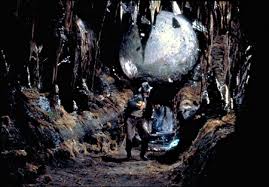
     I believe in Deathball.  I believe that, in the future, some form of it will be played.  If ABC can develop Wipeout, and CBS can do Survivor, then (SPOILER ALERT!) Deathball can't be far away.  A central turning point in the plot of the Futurama crew's "The Beast With A Billion Backs," the Deathball match is played on a giant Labyrinth board, with team captains high above the action in a control booth attempting to shift the horizontal and vertical orientation of the "playing board" for their respective teams below.  In essence, the game is one continual Indiana Jones sprints-from-the-stone thrill.  By the way, Farnsworth's team beats Wernstrom's.
   Spectacle: 10
   Originality: 9
   Playability: 5
     SFFSS: 24

1st - Rollerball (Rollerball)
Prepare to feel the wrath of Caan.
     Moon Pie may die because the system is rigged, but you cannot escape the unparalleled awesomeness of Rollerball.  In no way am I talking about the John McTiernan's 2002 steaming heap of incomprehensible garbage. I will give that"remake" no further consideration after the end of this sentence.  The 1975 Norman Jewison film is a true science fiction film, a speculation on the influence of corporations in the world, on the bloodlust that lies at the root of some popular entertainment, and on the price people might be willing to name to sell out their principles.  James Caan is cocky, confused, and just a little bit dumb in his portrayal of the great Rollerball jock Jonathan E, and John Houseman is creepy as the evil corporate overlord Bartholomew.
     But the real star of Rollerball is the, er, title sport.  What's not to like? Rollerskates, motorcycles, football helmets, spiked gloves.  The Rollerball itself is basically a cannonball.  The players take drugs for their pain, for energy, for fun.  There are riots in the stands.  The rules are changed in mid-season if things get boring.  People regularly die during matches -- the record being 9.  Nine players dead, that's a baseball team -- perhaps the Chicago Cubs.  Jewison said that, during breaks in the shooting, the stuntmen used to play FOR REAL for the extras sitting in the stands, and nobody got hurt.  Jewison also admitted that, at the time -- and maybe for all time -- he had assembled the greatest group of stuntmen in the history of cinema for the production.  This only contribute to the overall awesomeness of the film: no CGI and very few special effects.  Just pure guts, and a game that Caan and the stuntmen worked out for themselves in the best playground fashion.  Only with motorcycles. And did I mention the spikes?

Less than a gallon of blood, no foul.  Fire is perfectly fine.
     Now, I know that Jewison and the screenwriter William Harrison were trying to make a set of social commentaries (see above) and that's all fine, and much of the creepiness of the fictional future comes from the -- I'll say it -- eerie resemblance that some of it has to our own here in the present.  That's just good science fiction.  But as any satirist can tell you, sometimes, people end up responding in the wrong way and for the wrong reasons that you had intended.  Just ask Dave Chapelle.  Rollerball's message -- don't be bamboozled into accepting whatever bread and circus falls your way -- is more relevant than ever.  But if they started playing matches next year -- from Pittsburgh to Madrid and from Rome to Toyko -- I'd be hard pressed not to line up for season tickets.
   Spectacle: 10
   Originality: 8
   Playability: 10
     SFFSS: 28

PN Feedburner | PN iTunes | PN Twitter | PN Facebook | PN Video | PN Goodreads

9/24/10

PNodcast - Susanna Daniel's 'Stiltsville'

I sat down with Susanna Daniel in the cafe at Books and Books to talk about her excellent -- and first -- novel Stiltsville.  Born and raised in Miami -- with much time on the water and in one of those legendary stilt houses is Biscayne Bay -- Daniel's book is as much about people's relationships to place as to each other. You can listen to the broadcast feature here or subscribe via iTunes here.  Because of the extra audio editing needed to remove the charming cafe noise, the unscripted podcast will make an appearance at a later date.

PN Feedburner | PN iTunes | PN Twitter | PN Facebook | PN Video | PN Goodreads


9/23/10

Listener's Notes - From the CD Stack: Escreet, Garrison, Ross, Mainieri

Catching up with my listening for the past month, I turn first to a challenging but ultimately rewarding release from British pianist and composer John Escreet, whose Don't Fight The Inevitable (2010 Mythology Records) won't necessarily curl up in your lap and purr the first time you hear it.  But, as the title suggests, after some time spent with the songs and excellent playing on this album, you can't fight having an appreciation of what Escreet is going for.  Although I suspect he'd be quick to deny attempts at categorization, this album falls squarely in the camp of progressive modern jazz, as might be suggested by the one non-Escreet penned tune, "Charlie in the Parker," from Richard Muhal Abrhams -- he of the AACM and a 2010 NEA Jazz Master.  On that track, we hear Parker himself from an interview, announcing, ""Most likely in another 45 maybe 50 years some youngster will come along and take the style and really do something with it."  Audacious on the part of Escreet, to be sure.  With David Binney in the band (and serving as co-producer and co-writer on a couple of songs, Don't Fight the Inevitable has many high points, particularly the title track and Avaricious World, both of which clock in at over ten minutes each.  All in all, a mix of through-composed music, post-bop, and free jazz, Escreet's latest release gives us much to listen to and even more to think about.

     Tenor Matt Garrison makes all the right moves on Familiar Places (2010 D Clef Records), a carefully crafted release from a musician who has written some very strong tunes, assembled a strong group, and made sure that the album's production values are outstanding.  With his core band of Bruce Harris on trumpet, Zaccai Curtis on keyboards, Luques Curtis on bass, and Rodney Green on drums, Garrison sounds great on "Try Another Day," "You'll Know When You See Her," and the title track.  Much is made of Claudio Roditi sitting in on three of the tracks, and he does great work on trumpet and flugelhorn, but it seems at times that those songs belong on some other album.  Garrison has every right to feel confident in his group and in his writing to avoid what appear to be airplay reaches, as he does just fine in those places that are most familiar to him.

The always intriguing folks at Pirouet kindly provided me with Florian Ross' release Mechanism, which I have  listened to a number of times and liked very much, although it seems more a series of solo piano sketches than a full album of tunes.  Of the 17 tracks on this CD, the longest comes in at six minutes, while a couple are slightly over a minute.  Aside from John Coltrane's "Moment's Notice" (which came in at 9:10 on Blue Train, but is a paradoxically meditative 3:25 here), and Sergio Mihanovich's "Sometime Ago", all the tunes on Mechanism are from Ross' imagination.  The most memorable and distinctive is the title track, which makes more audacious use of digital looping than many of the other performances.  Impressive in its range of textures and moods, Mechanism works more as a collection of ambient pieces than as an out-and-out album that commands your full sit-up-and-pay-attention.

Lastly, and somewhat frustratingly, I come to a pair of double releases: Mike Mainieri, Crescent (2010 NYC Records) and the  Mike Mainieri/Marnix Busstra Quartet, Trinary Motion (2010 NYC Records). Both of these double CDs arrived within weeks of each other, so there was certainly much music to listen to from Mr. Mainieri and his vibraphone, and instrument I am probably more fond of than many people.  I find it hard to believe that Mainieri was attempting the sort of ambient textures that Florian Ross succeeds with on Mechanism.  Instead, Crescent and to a lesser extent Trinary Motion are both hampered by a simple dilution of content.  There is simply too much material -- three and half hours worth -- on these two releases.  Had Mainieri, who served as his own producer and also is the president of NYC Records, had selected the best hour of material from four CDs worth, I believe he'd have a hit on his hands.

PN Feedburner | PN iTunes | PN Twitter | PN Facebook | PN Video | PN Goodreads

9/22/10

Reader's Notes - Clark Terry's Blog

Legendary trumpeter Clark Terry -- of the Basie and Ellington bands, an influence on everyone from Miles Davis to Quincy Jones, State Department cultural ambassador and NEA Jazz Maste, all around great guy -- that Clark Terry has a blog.  Nuff said!

PN Feedburner | PN iTunes | PN Twitter | PN Facebook | PN Video | PN Goodreads

9/21/10

PN Video Jukebox - John Coltrane


This week's playlist has almost an hour of material from John Coltrane in performance -- or interviews with or about the great tenor.  In the middle of the play list, there's a long interview with Sonny Rollins about Trane, and the set wraps up with a two part audio interview conducted during a Coltrane tour of Japan in 1966.  Find the full playlist here.

PN Feedburner | PN iTunes | PN Twitter | PN Facebook | PN Video | PN Goodreads

9/20/10

Reader's Notes - Big Butter and Egg Man

Will Layman's new blog, Big Butter and Egg Man, featured a couple of entries last month that spoke to me on a more personal level, as they dealt with the question of how those of us who grew up in the 1970s -- one of the low points in jazz history, according to many -- managed to become fans of the music at all.  I submit for your reading pleasure Part 1 and Part 2.  Layman is a fine writer, a deep thinker, and he deserves all the readers he can get.  Enjoy.

PN Feedburner | PN iTunes | PN Twitter | PN Facebook | PN Video | PN Goodreads

9/19/10

Eater's Notes - Fast Food Secret Menus

Poutine - By request at KFC's in French-speaking Canada.
As an occasional viewer of the Travel Channel's Man v. Food, and as a person who tries to avoid extreme eating situations whenever the opportunity for one presents -- that is, I TRY -- I've been fascinated with, well, food that is bad for you.  And the larger the amount, the better.  All this is to say that one of the prime places to find interesting and unhealthy food are the usual fast food restaurants.  I've been hearing for years about the "secret menus" at one place or another -- In-n-Out Burger on the west coast, usually -- but apparently these "insider specialties" are catching on.  Whether it's the Wet Fries at Arby's, the Poutine at KFC, the Pie McFlurry at McDonald's, or the London Fog at Starbuck's, I vow one day to have given all of these a try.  Coupon Sherpa has a post from earlier in the year with one of the best lists I've found of secret menu items.

PN Feedburner | PN iTunes | PN Twitter | PN Facebook | PN Video | PN Goodreads